Split Taxi vs. Shuttle vs. Private Transfer: Which One Is Right for You?
You’ve just landed at Split Airport (SPU). Your bags are on the carousel, your phone is at 12% battery, and somewhere out there a hotel room, an Airbnb, or a ferry to Hvar is waiting. The last thing you want to figure out right now is transport.
But here’s the thing: the choice you make in the next five minutes can set the tone for your entire trip. A smooth, comfortable transfer starts your Dalmatian holiday on the right foot. A stressful one — stuck in a shuttle van, stopping at four other hotels, sweating in the August heat — doesn’t.
So let’s break it all down, honestly and clearly, so you can make the right call before you even land.
This guide covers three main options available at Split Airport: standard taxis, shared shuttle buses, and private transfers. We compare cost, comfort, flexibility, and reliability — and tell you exactly who each option suits best.
The three options explained
Standard taxi
Taxis are available at the taxi rank just outside the arrivals hall. You can hail one on the spot or book via apps like Bolt or a local provider. For short distances — say, Split city centre or Trogir — a taxi can be a quick and convenient solution. Prices are metered, which offers some transparency, though surge pricing and luggage fees can push the cost up, especially in high season.
The downside? During summer, queues at the taxi rank can be long, drivers may not always speak English, and there’s no guarantee of a vehicle large enough for your whole group and luggage. For longer routes to Makarska, Dubrovnik, or the islands, taxis can become surprisingly expensive — and you have little control over the experience once you’re in.
Shared shuttle bus
Airport shuttle services connect Split Airport with Split city centre and a handful of other destinations on a fixed schedule. They are the cheapest option by far, which makes them attractive for solo travellers on a tight budget. However, cheap comes with trade-offs: you share the vehicle with strangers, the route may include multiple stops, and the schedule does not bend for delayed flights. If you miss your slot, you wait.
Shuttles work well for single travellers going straight to the city centre with light luggage and no particular time pressure. For families, groups, or anyone heading to a destination outside the main shuttle routes, they quickly become impractical.
Private transfer
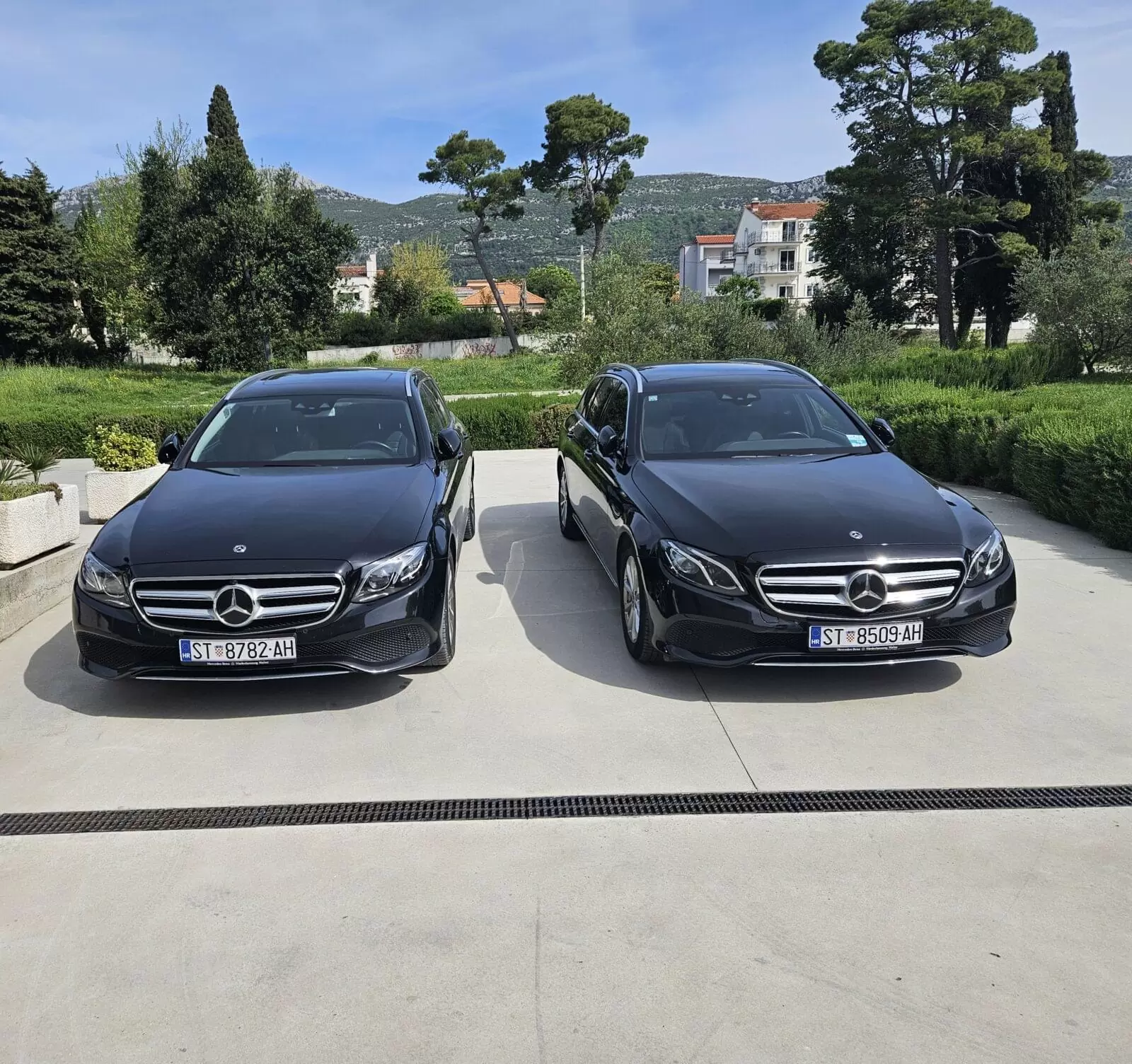
A private transfer means a dedicated vehicle and driver booked exclusively for you — or your group. You are met at arrivals with your name on a sign, helped with your bags, and driven directly to your destination. No stops, no waiting for other passengers, no fixed departure time. The driver monitors your flight and adjusts if you’re delayed.
Private transfers are priced per vehicle rather than per person, which means the more people in your group, the closer the per-head cost gets to a taxi or even a shuttle. For a family of four, or two couples travelling together, the maths often works out in favour of private.
Real-world scenarios
Abstract comparisons only go so far. Let’s look at who actually benefits from each option.
Scenario 1: Solo traveller, Split city centre, budget-conscious
If you’re travelling alone, have one bag, and are heading directly into Split, the shuttle is a perfectly sensible choice. It’s inexpensive, runs regularly, and drops you at a central point. Just make sure your accommodation isn’t far from the drop-off, and accept that your departure time is the shuttle’s departure time — not yours.
Scenario 2: Family of four with luggage, heading to Makarska
This is where private transfer wins, clearly. Four people in a shuttle — if it even goes to Makarska — means four separate tickets, plus dealing with pushchairs, bags, and tired children in a shared vehicle. A private transfer for this group costs only slightly more per person and delivers an entirely different experience: the driver loads your luggage, the air conditioning is working, and you arrive relaxed.
Scenario 3: Couple on a tight schedule, connecting to a ferry
If you have a ferry to catch, you cannot rely on a shuttle schedule or a taxi queue. You need the certainty of a private transfer: your driver is waiting regardless of any delay, the route is direct, and you will not miss your sailing because the shuttle was full.
Scenario 4: Group of friends heading to Dubrovnik
A taxi to Dubrovnik is a long, metered ride with an unpredictable final cost. A shared shuttle almost certainly does not cover this route. A private transfer gives you a fixed price, a comfortable vehicle, and the option to ask the driver to stop briefly along the Adriatic coast if time allows — something a taxi driver on the meter has little incentive to accommodate.
The honest answer on cost
People often assume private transfers are significantly more expensive than taxis. In practice, the gap is much smaller than expected — particularly for longer routes. A taxi from Split Airport to Makarska, metered over 70 kilometres in summer traffic, can reach a very similar price to a fixed-rate private transfer. The difference is that with a private transfer, you know the price before you get in the car.
Shuttles remain the cheapest option in absolute terms. But if you are sharing the cost across two or more people, the savings shrink quickly. Factor in the value of arriving directly at your accommodation rather than a shared drop-off point, and the calculation starts to favour private for most travellers who aren’t strictly solo.
What to watch out for
Regardless of which option you choose, a few tips are worth keeping in mind when travelling through Split Airport in summer:
- Book in advance whenever possible — availability tightens significantly from June through August.
- Confirm your pick-up point before you land: arrivals hall, car park, or curbside varies by provider.
- Check whether your driver accepts card payments if you prefer not to carry cash.
- For taxi app rides (Bolt etc.), confirm the vehicle is licensed and the driver’s name matches the booking before getting in.
- If you have young children, ask your transfer provider in advance about child seats — reputable private transfer companies include them at no extra cost.
So which one is actually right for you?
If you are travelling solo to Split centre with flexible timing and light luggage, the shuttle does the job. If you need something fast and didn’t pre-book, a taxi works fine for short distances. But if you are travelling with a group, heading further down the coast, or simply want to arrive without stress — a private transfer is the clearest choice.
For most holiday travellers heading to the Dalmatian coast, a private transfer is not a luxury — it is simply the most sensible way to start the holiday.
Simple

Expand
the experience

Support
24/7

Licensed
drivers

Local
company

Fixed price
on request